Posts mit dem Label opinions werden angezeigt. Alle Posts anzeigen

Dienstag, 22. April 2014

Hockey is a vulgar, violent, classless and offensive sport. Deal with it.

The banner says "video review" in german.

A couple of weeks ago, a trio of Philadelphia Flyers fans went to a game of their team in Pittsburgh where the Flyers once again beat the Penguins as they have done so ever since their new arena opened. The story made the news because the three fans wore Flyers jerseys reading "Malkin Blows", "Crosby Sucks" and "Neal Swallows" on the name plates paired with the jersey number of the respective player. They were asked by the arena staff to take those jerseys off or wear them inside out and they complied.

I am a big defender of free speech. Those jerseys were definitely tacky, dumb, and a jersey foul. Not sure why people would deem it worth the ridiculous price that NHL jerseys cost for such a dumb and unfunny display, but if they want to, they should be able to wear it. However, free speech only protects you from government censorship. When visiting a private business you can still be asked to straighten up your conduct and it should be common courtesy to behave like a regular human being and not like an absolute moron, the arbiter of which is the host.

What surprised me however was the reaction around the internet. People were declaring that something like this has no place in the game, and that the censorship was necessary to protect children from being exposed to sexual concepts, putting them and their parents into an embarrassing situation.

Excuse me, but have those people ever been to a hockey game? Or at least seen one on TV?

Hockey is a vulgar sport. It is modern day gladiatorial combat where people ram into each other at high velocities and throw any conceivable body part in front of pucks traveling at more than 100km/h. It's a sport played by people with clubs in their hands and knives on their feet. And you are watching a league that allows bare-knuckle boxing during its games and the only punishment is that both combatants can not be on the ice for the first 5 minutes after the fight.

And with this amount of violence, comes contempt for the opponent. They are not only taking money out of each others pockets by denying them bonuses for Stanley Cup victories or individual performances, they are also trying to make each other suffer, both physically and mentally, and if there is an actual injury so be it.

And with this contempt comes the expected language. It's not hard to curse out an opponent or express your general disgust with a person that just seconds ago tried to break the knee-caps of a teammate. Chirps can also be humorous, as trying to make fun of an opponent also establishes a form of dominance, but they are rarely meant to be less than degrading to the opposition. This contempt is not only felt by the players on the ice, but also the audience in the stands and in front of the TV screens.

Of course there are certain lines to be drawn. For example the NHL and the organization You Can Play has recently started a campaign to eradicate homophobic slurs within the League, and I say more power to them. Homophobia is an issue in the same vain as racism, and while people may earn your disgust for attempting to give another player a concussion, they definitely aren't liable for how they look or who they are attracted to. Or as Fat Mike sings in Don't call me White: "I can except responsibility for what I've done, but not for who I am".

This ties into a concept that I will for now label "real-life entertainment" and into which hockey falls. You see, unlike other forms of entertainment, hockey is not fiction. There is no absolute separation in which the actions portrayed have no direct influence on the real world. When Frank Miller draws a person gruesomely shot to death in a comic book, nobody actually died. And while art & entertainment can teach people what is correct and what behavior can lead to what consequences, there is always the thought in the back of the mind that this is not real and not necessarily a guide to follow, but an exploration of what could happen.

Hockey on the other hand takes place within the real world. Hockey players are real people and if they break a leg or suffer a concussion, it's not just an interesting storyline to explore, but a real event with real consequences that affect real people. And therein lies the worry of the parents I mentioned earlier, in which naive children emulate their skating idols because they don't know any better and the separation between the world of hockey and real society doesn't really exist to them.

However, while this separation is not as strong as for example with books or movies, there is still a separation of context. Hockey is not actual society. While in hockey people can punch each other silly, get smashed in the face with pucks and sticks, and suffer all sorts of injures, there are hardly any real consequences like we would see in the "real world" for similar behavior. Unless there are some extreme circumstances, nobody will be charged with assault or battery.

On a less violent side of things, a coach grabbing his balls or a player making fun of an opponent who just suffered a concussion is the tip of the iceberg really, and a lot of other things are being said and gestured between the players on the ice that the cameras and microphones do not pick up or the press often deliberately ignores. How often have you heard the commentators on a hockey game excuse themselves for shutting down a microphone because it's too close to a verbal joust between two players?

And the same goes for the audience. Within the context of the game, certain things are to be expected. Whether it's the three numbskulls I mentioned earlier, someone making a T-Shirt of the "Wakey Wakey Backes" incident, or the crowd in New Jersey chanting "Rangers suck, Flyers swallow!" on a regular basis, the level of the audience only matches what is already seen and heard on the ice.

What's strange is that these instances make the headlines when the violence and vulgarity of the sport is regularly on full display? I for my part find flying elbows and knee-on-knee collisions much more offensive than a word or a gesture. Yet some of that violence is exactly what draws people to the sport. Not just the big, but hopefully legal hits, but there is a real culture and fanbase for hockey fights which is by definition a penalty, something that is not allowed within regular play.

If I had to draw a parallel, I would call going to a hockey game like going to see an R-Rated movie. Maybe your children are old enough, and you had a good talking to them putting it into context that the behavior of the people you are watching is under special circumstances and not something they should emulate in every day life. However, going into either and then being appalled by what you see and are having a hard time explaining it to your children, nieces, nephews or what have you is your own fault.

Hockey is a violent, vulgar, and in certain ways offensive sport. You know what it is, and it simply is hockey. It is on you whether you want to watch it and who of your immediate family you want to expose to it.

Mittwoch, 9. April 2014

The Flyers are a raging success, and Claude Giroux is their captain


The Philadelphia Flyers had a terrible start to the season. This is no secret. The reasons are many. They had tuned out the coach. The training camp was an absolute disaster. Claude Giroux suffered a freak golf injury during the offseason and missed training camp entirely. They had a terrible time to find the net, etc. These things aren't as much excuses as they are observations.

Then the Flyers were at a 1-7-0 record and seemingly at the end of their wits, team captain Claude Giroux had the following to say:

"We're not far off at all. How many points are we out, six? To think of the start that we had and we're that close. We never thought about not making the playoffs. We've got to go game by game and we will make the playoffs."


Reading over it now, the statement seems a little bit innocuous, but nevertheless a lot of media outlets picked it up as a sort of Mark Messier-esque guarantee. And so did fans, eager to have a laugh at the expense of a downed opponent. Just take a look at the commentary sections of this article on Yahoo, or this article on ESPN.

Commentators such as Ryan Lambert, the Bill O'Reilly of hockey, also had their field day dancing on what seemed to be a grave already. Particularly after the Flyers hit rock bottom in their lousy and embarrassing game against the Capitals. The cake probably takes the column entitled "Philadelphia Flyers are a screaming disaster and Claude Giroux is its captain".

Now we are here, 5 months later, and the Flyers clinched a playoff berth with a 5-2 win over the Florida Panthers yesterday night.

While it would be a delight to go back and pick out some choice comments from the naysayers, but I think looking at the above mentioned comment sections speaks for itself. Rather, let's take a look at some of the factors why the Flyers made that remarkable turnaround.

First must be Claude Giroux. After the statement he made he kept his end of the bargain, placing first on the team in points and goals, and is as of this writing 4th in the NHL in points. After a brutal start that took him 6 games for the first assist and 15 games to score his first goal, that is quite something to behold. It even places him into the Hart Trophy race. I've made my feelings about this known, though unfortunately the Professional Hockey Writers' Association treats it as a general, league-wide MVP award so it is a foregone conclusion that Sidney Crosby is going to win it.

Claude Giroux also had several late-game heroic scenes, such as overtime winners against Chicago and Columbus in rather spectacular fashion, which showcases the Flyers resiliency. They have a ton of games in which they trailed at some point in the third only to tie it back up and get at least one point, or even win outright.

Special teams play has also been a constant factor. The Flyers are ranked 10th in Power play percentage and 6th in the penalty kill. The guys over at Broad Street Hockey have an excellent article on the Flyers PK unit and how they make their opponents lives tough through shot suppression.

The Flyers also were horribly snakebitten in the early part of the season. They only scored 11 goals in the first 8 games of their season. Since then everybody has stepped up, as the Flyers can now boast that they have 7 different players that have scored at least 20 goals. They are the only team sporting that number.

All of this is nice and fine, but the season is not over yet. They still have to vie for positioning. They are most likely playing the Rangers in the first round of the playoffs, and home-ice advantage will be paramount. They have a game in hand, but since the Rangers hold the tiebreaker the Flyers need them to screw up at some point, though their schedule is rather easy.

Montag, 7. April 2014

In defense of Zac Rinaldo (kind of)


Zac Rinaldo is a sword with two edges and this weekend very much illustrated this. On Saturday the Flyers played the Bruins, who have been a thorn in the side of the Flyers ever since the Flyers beat them in that miraculous 4-3 comeback in 2010. Rinaldo leveled Milan Lucic on a clean hit in the opening minutes, mirroring a scene from the previous game just a week earlier in which Rinaldo smashed Jarome Iginla, then had to fight him as Iggy was kind of pissed about it. This time Rinaldo kept his gloves on while Lucic did not, and Lucic ended up taking the only penalty on the incident.

Unfortunately the Flyers and their lately frigid power play failed to take advantage of that advantage. The game then became somewhat stale-matey as the Flyers hung with the Bruins for the first 40 minutes. However, they got absolutely destroyed in the 3rd period and lost 5-2. Not a good showing and Lucic got the last laugh with two goals in the game.

The very next day the Flyers played the Sabres at home. Rinaldo for his part took advantage of his recently increased ice time, skating with Matt Read and Sean Couturier on the 3rd line, by scoring a goal. With Jay Rosehill scoring against the Bruins and The Undertaker losing at Wrestlemania some people see it as a sign of the apocalypse. Other people were just happy he found some success, particularly his little brother, who is just adorable.

However, then Zac had to go ahead and lose all the trust and respect he recently earned by hitting Sabres rookie defenseman Chad Ruhwedel in the head.

This was not a good hit. It was a direct contact with the head and no body contact at all. Rinaldo also appears to leap into the hit. He is also a repeat offender from an incident in 2012, in which the suspension was also rather warranted. Also, Ruhwedel suffered a concussion from the hit. Combine all these facts together and Rinaldo is staring at a lengthy suspension at the hands of the Department of Player Safety in the immediate future.

So let me get this out of the way first, I am not going to defend the hit because there is nothing to defend. To bring out the cliche, it is the kind of hit the NHL is attempting to legislate out of the game, and I am pretty okay with that. Players make mistakes and will have to suffer the consequences for them.

What I will try to defend is Zac Rinaldo, the player.

Immediately following the hit and the reporting on it, the crow calls came. The peanut gallery on various hockey sites were condemning the hit (which is correct) and questioning why Rinaldo is even in the NHL (which is not).

That Rinaldo has a reputation problem is almost an understatement, tracing way back to his days in the OHL and before that. He has pretty much always been a mucker and a hitter, just as he is now. He was never a scoring threat or anything like that. He is a pest who makes his living by putting the fear into people and giving them bruises from big hits. It is a fine line he plays on, a fact that he is aware of, and for 99% of the time he stays on the right side of that line. But with playing on that line also comes stepping over it on occasion, either by mistake or intent, and suffering the consequences. A price he is willing to pay. However, that hardly warrants the label of "dirty" being placed on him.

From what I can tell out of interviews and how he presents himself in documentary scenes like on 24/7 Road to the Winter Classic, he is also an earnest person who accepts his role on the team and does what he can to advance it. He also has something child-like in him, like a kid in a candy store, casting him in a bit of a locker-room-guy role as his enthusiasm appears to be quite infectious.

What I do not get is how other people can not see or appreciate this fact. For the most part it just has to be the desire of vengeance. Rinaldo is the type of player who goes under the skin of his opponents, both those on the ice and the fans thereof. Nobody likes to be hit, and Rinaldo hits hard and often. To roll on another cliche: He's the kind of player you like to have on your team, but hate when he's on the opposing one.

And therein lies the core of the problem, familiarity. Even his biggest detractors must have had a similar player on their team at one time or another if they don't do now. Teams need these kinds of players as they bring some raw energy to the table, and the fans of the teams often love those little balls of enthusiasm. It is of course on the team to make use of this energy, to form it into something useful and valuable, rather than leaving it dormant or having it explode in their face.

Perhaps another current Flyer is a poster boy for this, Steve Downie. Downie is somewhat of a more talented version of Rinaldo, a mucker and a hitter but with a bit more of a scoring touch. He too was troubled by a bad reputation coming out of juniors, and his energy exploded into senseless destruction when he hit Dean McArmond in preseason all those years ago. However, after he was traded to Tampa and under the guidance of figures like Rick Tocchet (who would be another player in a similar vein) formed a very nice NHL career for himself.

Watching Rinaldo has given me a bit more of appreciating for other players of his type on other teams, even if I despise them for the moment. As Jeff Marek like to say, even the worst player in the NHL is miles ahead of any average Joe from the street in terms of hockey skill, even the streets in Canada. Players like Zac Rinaldo are contributing something to their team and are far more skilled than people give them credit for, so even if they cross a line and make a mistake, I think it's just entirely unfair to immediately call for their dismissal from the league. It would also be hypocritical to condemn players to it when the same kind of player with the same types of plays would rouse excitement if he was on your own team.

What my worry is though is that other people can't see through this, including Brendan Shanahan and the Department of Player Safety. They seem to go a lot harsher on low-level players like Rinaldo than on players with a larger profile on the score sheet. That being said the hit does definitely warrant a suspension, though I hope it isn't primarily based on Rinaldo's embellished reputation but rather on the action itself.

Mittwoch, 2. April 2014

Yes, the shootout is still important


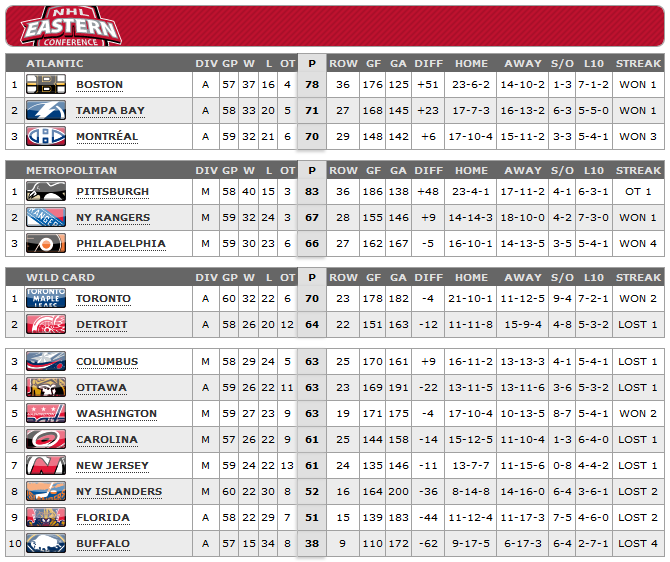
With the playoffs drawing closer and teams clinching, I basically stare at the standings at least once a day, usually more often than that, at the NHL.com standings. One of the most interesting numbers in the standings is the Shootout wins and losses. I use it as a barometer on the strength of teams, particularly those on the bubble. Good teams win and are able to deny their opponents points by outscoring them in regulation, or at least punch through in overtime. The number of shootouts they are involved in will generally be low. Other teams have to rely on the shootout scrap points together. However, this also means that they gift points to their opponents, making it overall tougher for themselves.

Personally I don't really mind the shootout as much as the fact that it shouldn't be worth the same as a regulation win (as explained in a previous blog post). Even the NHL kind of admits to that by making win totals excluding the shootout the first tie-breaker in the standings (provided equal number of games played). However, it is definitely a crutch some teams exploit and I call teams whose success is based in it paper tigers, fakes which look stronger than they actually are.

It is undeniable that some teams make the playoffs based on the shootout. As a Flyers fan people are quick to bring up the season-ending shootout in the last game of the regular season against the Rangers in 2010. It came down to a shootout, with the winner of it making the playoffs and the loser being on the outside looking in. The Flyers luckily made it, starting them on their run that ended in Game 6 of the Stanley Cup Final.

The funny thing though is that it's not the Flyers who profited from the existence of the shootout that year: It was the Boston Bruins. The Bruins finished 3 points ahead of the Flyers and 4 points ahead of the Rangers. However, this lead was based in the fact that the Bruins participated in 19 shootouts that year, winning 10 of them. They were 14-13 in games going over regulation time that year. In comparison the Flyers had a 4-3 record in shootouts that year, with a 6-6 record in games decided in OT or the Shootout. The Rangers were 4-11 in games decided past regulation time. In most other point systems, such as the three point system I would like to have in the NHL, the Flyers and Rangers would have already been qualified before the final game of the season, and the Bruins would have been eliminated.

A similar example to the 09-10 Bruins can also be seen this year in the Washington Capitals. They too have participated in 19 shootouts, winning 9 of them. They are for now on the bubble, though two points behind the Blue Jackets who have a game in hand on the Capitals, making me think the Caps won't make it. The Capitals saw 25 of their 76 games played so far this season go into overtime, often by their own inability to hold a lead. It may very well be the reason they are on the outside looking in, as they have bled extra points to their opponents. However, without the extra points they earned in OT they wouldn't even have the chance to make the playoffs either.

On the flipside we have the New Jersey Devils who had to 11 shootouts this year, losing all of them. Yesterday night they lost to Buffalo in a 9-round shootout despite scoring two goals themselves, tripling the season total on successful shootout attempts for the year. They are now 3-for-39 in shootout attempts on the year, which is not surprising considering that their head coach Pete DeBoer does not practice the shootout.

Seriously, how does this happen in a league that has the shootout? If the Devils went as much as 5-6 in their 11 shootouts this year, they would now have 85 points, pushing them into a playoff position ahead of the Red Wings and Blue Jackets. If they had been able to flip their shootout record around, going 11-0, they'd be 2nd in the division and on the brink of clinching a playoff spot. By choosing not to practice this part of the game the Devils are essentially surrendering points to their opponents from the outset, and the importance of these points becomes more and more evident with every passing day this time of year.

Yes, the shootout does not exist in the playoffs. And yes, a team should not be reliant on the shootout to win a hockey game. But as much as I think that the shootout win should not be as valuable as a regulation win, matter of fact is that the shootout is still important and an opportunity to improve point totals and positions in the standings. Not even practicing the shootout should be immediate grounds of termination for any head coach.

However, this also makes me wonder about the Flyers. The last two games were decided in a shootout, losing both of them to the Bruins and Blues. It is good that they got the equivalent points as a win from two games against the two best teams in the league and giving them the extra points does not hurt the Flyers too much, but they are now again at a 3-7 record in the shootout this year. These are similar numbers to the last couple of seasons. In overall, the Flyers are 11-23 in shootouts since 2010, and Berube appears to not have put any more emphasis on the shootout than Laviolette did before him.

While it is always a delight to watch players like Claude Giroux show off their skillset in the shootout, it would be nice to actually win a couple of them. Particularly now as the Flyers are struggling to gain home-ice advantage. The Flyers are pretty much set to face-off with the Rangers in the first round, and they have a terrible record at MSG for the last couple of seasons. Leaving these points on the table could very well cost them dearly.

Dienstag, 25. März 2014

James Neal should not be made of teflon

Here we see Neal inflicting grievous harm before swiftly exiting the ice for the bench.
It should be no secret that I do not like the Pittsburgh Penguins. Besides being a pain in the ass and currently involved in a heated rivalry with the Flyers, I consider them to be an aberration in sports. They are a franchise that has been sustained not by hard work, but almost entirely by luck. They had the good fortune to suck at the right time, unlike Panthers, Blue Jackets or Coyotes for example. First in the 80s they win the Mario Lemieux sweepstakes, and more recently in the mid 2000s they drafted first or second overall in four consecutive years yielding them Marc-Andre Fleury, Jordan Staal, and the generational talents of Evgeni Malkin and Sidney Crosby. Crosby is of course the biggest example of the Penguins good fortune, his draft choice being awarded through an actual lottery involving every NHL team.

What is worse however is how the Flyers and the Penguins are being viewed by outsiders and more casual hockey fans. The Flyers have earned a reputation in the 70s as the Broad Street Bullies, a mean and physical team. They have suffered from this reputation ever since, never being awarded the benefit of doubt whenever something less than wholesome has happened.

On the other hand the Penguins are the darlings of the NHL and presented through its marketing, which routinely focuses on them due the presence of Sidney Crosby, as the dynasty-to-be and the clean-cut shining example of how a franchise should conduct itself.

However, anybody with more than a passing familiarity with the NHL knows that nothing is further from the truth. The Penguins are just as rotten as the rest of the NHL. They commit cheapshots and penalties just like everybody else. However, considering that they have employed the consensus dirtiest player in the league Matt Cooke for a long time they may have been even worse than the rest while masquerading as sheep.

Matt Cooke's history of dirty play has been chronicled pretty well. But to give credit where it is due, he has actually managed to turn his career around in the wake of a 10 game suspension and make his living as a defensively responsible player and penalty killer, as opposed to a cheapshot artist. He is still a pest, but at least he is a clean one. Cooke is however tainted which is why the Penguins opted to not bring him back during the 2013 offseason.

In his wake the Penguins quickly found a successor for the mantle of local cheapshot artist, and his name is James Neal. Neal is a very skilled player, has a great shot and is a genuine power forward impressing with size. He is also dirtier than a sewer rat, routinely getting his elbow and stick out against opposing players for little to no reason, often just because there is an opportunity.

What is odd however is how Neal appears to have somehow snuck into the blind spot of the Department of Player Safety, either being punished with a slap on the wrist or not at all.

Take for example his hit on Sean Couturier from the 2012 playoffs. It was a leaping headshot at an unsuspecting player who was not in control of the puck and hadn't been for several seconds. Neal was not called on a penalty, giving him the opportunity to deliver another cheapshot only seconds later on Claude Giroux. Neal was finally kicked out of the game for that one and was assessed a 1 game suspension for his hit on Giroux, but got no discipline at all for his hit on Couturier. How the NHL at all bites on Neal's excuse that he tried to brace himself for the hit on Couturier and it was incidental is beyond me, considering how deliberately he goes after Giroux only moments later. Seems to me like he was on the warpath from the get go.

What makes this decision truly bizarre is the fact that only a couple of days later, a similar incident between Raffi Torres of the Phoenix Coyotes and Marian Hossa of the Chicago Blackhawks occurred. The hit was in my opinion essentially identical to the one between Neal and Couturier. An unsuspecting player who has lost the puck gets drilled by a predatory, leaping hit. The only real difference is that there was a stretcher involved as Hossa had to be transported off the ice, unable to skate by himself. Torres was suspended initially for 25 games, which would later be reduced to 21.

While there is much to be said about Torres established history as opposed to Neal's only burgeoning reputation at the time, as well as the fact that Torres caused a severe injury while Neal thankfully did not, I can not understand for the life of me how the difference between the two incidents is 25 games.


Fast foward to this week. James Neal has now earned himself quite the rap sheet, over the last couple of years, including a 5 game suspension this season after planting a knee in the head of a downed Brad Marchand from the Bruins. This in and off itself should already be a travesty considering how obvious and deliberate he undertook that penalty.

However, to make things worse, this week Neal crosschecked Red Wings forward Luke Glendening in the head. Very deliberate and opportunistic. Considering how much the NHL is attempting to limit contact with heads in order to prevent injuries, and given Neal's status as a repeat offender, this should be another lengthy suspension, right?

Wrong. The NHL chose to only fine Neal for $5,000. What. The. ****. Compare this to the crosscheck Jesse Boulerice delivered to Ryan Kesler in 2007, which earned Boulerice a 25 game suspension. And this was before the NHL declared war on concussions. Do I think Boulerice's hit was worse? Most definitely. The puck was long gone and Boulerice made a bee-line for Kesler for no damn reason in a game which was decided for a while. Is there 25 games worth of difference between the two incidents? Most definitely not.

Or as a different example, here is Washington's Nicklas Backstrom cross-checking Bruin's forward Rich Peverley in the head. That at least got him a 1 game suspension in the playoffs.

The Department of Player Safety has a reputation problem as it is, with many of its decisions appearing to be completely arbitrary and not rooted in precedent or any formal logic whatsoever. There also seem to be different sets of rules applied to high scoring star players and bottom six plugs. And in the playoffs the entire system seems to go straight out of the window anyway. Stuff like the above is definitely not helping.

Something also needs to be said for the lack of initiative at the hands of the Penguins. Yes, Matt Cooke improved himself after a stern talking to by the Pens brass, but this was only after being severely punished by the NHL. For years they let things slide and let Cooke run amok before actually stepping in. And they seem to be content with letting Neal continue down the same path.

It also doesn't appear that Neal is at all remorseful or has any understanding of the consequences of his conduct. From Shanahan's videos we get relays of his cheap excuses. When asked by reporters he never admits fault or shows regret, and even on the plays themselves he is quick to exit for the bench rather than face the music.

Somebody has to step in and make Neal actually feel the some punishment for his transgressions, which appear to have become routine for him. I just hope that it is either the Department of Player Safety finally wising up, or the Penguins leadership doing what is necessary. Otherwise we might see things come down the way they did in 2011 when the Islanders chose to goon it up against the Penguins as they did not believe the NHL had served them in correcting previous wrongs inflicted at the hands of the Penguins. This prompted Mario Lemieux to write an angry letter to the NHL calling for stronger discipline and sharper suspensions, despite his own team being mostly the beneficiary of this lax situation and the root cause in how it got that far.

The situation is also becoming increasingly more dangerous. It is already borderline miraculous as it is that Neal hasn't severely injured a player already, but every cheapshot is a new opportunity for this to happen. I hope for all parties involved Neal corrects his path before then.

Somebody has to step in, as the lack of initiative to punish a "star" player like Neal is slowly but surely becoming an untenable embarrassment to the league.

Montag, 24. März 2014

Geeks and Hockey

There is nothing weird about this picture.
I am a geek. I'm a computer programmer by trade. I watch anime. I play games. I read books. All that and more. But being a geek isn't a bad thing. Being a geek just means that you like something to actually invest yourself into it, and the term itself is mostly appropriated to refer to something that is about pop culture or something more cerebral. There is often a rivalry or mutual disdain portrayed between jocks and geeks in films such as Revenge of the Nerds. But to me jocks are just sports-geeks, and geeks are just brain-jocks. It's all good. Just do your what you like and let others do the same.

One of the geekeries I do is Magic: The Gathering. For those who do not know, it is a collectible card game and it has a huge player-base. The largest public tournaments are called Grand Prix. There are about 50 Grand Prix a year, and each draws upwards of a thousand people pretty easily. For example this past weekend was Grand Prix Vienna 2014 in which I was one of 1208 players.

Since I am a geek and I have an obvious interest in hockey, I'm also always looking for intersections between the two, and the GP was a treasure trove for it. First I came into talk with one of the vendors who was sporting a Canadiens hat. He asked me about the Flyers Winter Classic cap, at first assuming I was from Philly. Turns out he is from Montreal but was at the event to do some work for a french shop. He however had already noticed that there was a lot of NHL paraphernalia in the room.

Over the weekend I spotted a guy wearing a Penguins sweatshirt, two diffferent Canucks T-Shirts (one being laser-spaghetti, one being in the current design with Daniel Sedin's name and number on the back), a Kopitar LA Kings jersey (from before the most recent redesign), a Sharks hat, a Sharks T-Shirt, and an Islanders sticker on a messenger bag. (Speaking of the Islanders, here's the Islanders blog Lighthouse Hockey having some fun with Magic cards). And yes, the inevitable matchup between me and the guy in the Penguins sweatshirt did happen, and I prevailed.

For context, I saw nobody wearing any football shirts, which I would have thought much more common in Austria (and by football I mean the sport where all the players kick a ball with your feet). I also saw no NBA merchandise except for one person wearing a Sixers hat. The same person also wore an Eagles NFL jersey, and making the rounds with a friend who was wearing a Seahawks jersey. On the final day of competition one player also wore a Ravens jersey. However, that's about it for sports merchandise, the NHL having the upper hand there as far as I saw.

Now maybe this is me having a selection bias, but for a while I've noticed hockey to be a sport more frequently being picked up as an interest by geeks. I several online-acquaintances who travel in similar circles as me and studied at RIT. They either became hockey fans there, or already were and brought some of their friends with no prior relationship to hockey into the fold.

It is also one of the reasons, if a very minor one, I think hockey succeeded and gained a steady fanbase in places like San Jose (smack dab in the middle of Silicon Valley) and Raleigh (center of the Research Triangle) as students from North-Eastern Tech schools such as MIT or RIT that also have a hockey program often migrate to those places. It's also a minor reason why I think hockey would succeed in Seattle, though the city being placed in the north, having an untapped and enormous population, and the proximity to Canada with the built in rivalry with the Canucks far outweigh it.

In any case, I find it great that hockey has such a wide appeal, even in places where stereotypical it would be believed to be shunned.

Freitag, 28. Februar 2014

The Franchise Player and the Captaincy

The term "Franchise Player" gets thrown around a lot, and I'm not sure there is a consensus about what the term actually means. To many people it seems to designate simply the best player on a team. The star if you will. To me it simply means the backbone of the team to build around. While there is a lot of overlap between the two definitions, there are also differences which I believe need to be stressed.

In both cases the one player a team is putting its bets on, hoping that he will lead them into the promised land and win the Stanley Cup. The biggest difference between the star and the backbone is how they attempt to accomplish this. The star is about skill and talent, attempting to drag up the team by their own effort and contributions. The backbone on the other hand is about leadership and responsibility, furthering team accomplishment by getting other players to play better and impacting the team by doing more than just scoring. He is often tasked with the tough minutes against the opponents top lines and taking the assignments nobody else wants. This also makes him often the prime candidate for the Captaincy of a team.

Of course this doesn't mean that a player can't do both, but it may be a lot better for a team if they don't. Responsibilities should be distributed according to a players capabilities, and one player being forced to doing it all can be very stressful and also break him. Of course a team has a much better chance to succeed if it has multiple players of a "franchise player" caliber, as long as they span both definitions, and they will have it a lot harder if they are missing either or both.

A positive example from the past are the Montreal Canadiens of the 70s and 80s. You had Bob Gainey as the Backbone, and players like Guy Lafleur and Ken Dryden as the stars. Bob Gainey a consummate professional and defensive specialist held the captaincy from 1981 to his retirement in 1989, earning himself the nickname "Le Capitaine". He allowed the Canadians to function and succeed even though his contributions rarely showed on the scoreboard. They even invented an award, the Frank J. Selke Trophy, because they had to give him something.

A modern day example in a similar manner could be the combination of Jonathan Toews and Patrick Kane in Chicago. While Kane is a high-flying superstar, impressing with his scoring ability, Toews takes responsibility in leading the team. Toews is the captain of the Blackhawks and while he leads by example, he also knows how to get his team to perform.

Not being careful in the selection process of the captaincy can also severely backfire, as not every star player is also capable of playing the role of the backbone. Take a look at the Washington Capitals and you know what I mean. While Alex Ovechkin is a bona fide super star, a human scoring machine and a constant threat on the ice, he does not appear to have the leadership qualities required from a captain, as evident by his shrinking presence in the face of adversity. This could be observed throughout the years and the routine early exits from the playoffs, as well as most recently in the Olympics and the poor performance of the Russian national team.

This forces other, more veteran players to speak up, such as was seen in 2010 during 24/7, when Mike Knuble had to speak up and attempt to bring the Capitals out of a slump. The Capitals are also now doomed, as they can hardly take the captaincy away from Ovechkin even if they were to find a player show greater leadership qualities.

Perhaps this also illustrates a different point. When discussing this topic on a hockey board I regularly visit, the main focus was Patrice Bergeron of the Boston Bruins. I consider Bergeron a franchise player by my definition, a player who will take on the tough minutes and get other players to perform while providing constant contributions, even if they aren't earth-shattering. Another poster disagreed, declaring him only an exceptional role player and drawing parallels to Bobby Holik with the implications about Holik's ridiculous contract he signed with the Rangers.

However, the difference between a backbone-type "franchise player" and an "exceptional role player" was left undefined. To me, each player on a team needs a role he has to fulfill, with those roles being distributed according to the abilities of each player. If Bergeron's role is taking the defensive assignments, and is completing his tasks in an exceptional manner to the point where he is a cornerstone of the success of the franchise, he should very well be considered a franchise player.

For my favorite team, I hope that Sean Couturier becomes a franchise player in the same way Bergeron is to the Bruins. Couturier already is one of the best defensive forwards in the NHL, and while his offensive output still needs to improve, he provides great value to the team as a whole. He definitely has the potential to be a fundamental building block for the Philadelphia Flyers and he has to be if the Flyers want to find success in the near future.

Donnerstag, 20. Februar 2014

Why Vinny has to go

When the Winter Olympics come to a close and the NHL starts back up, there will only be a couple of games left before the Trade deadline and thus it is time for a lot of teams to evaluate their current positions and expectations. Are they buyers or sellers? Should they make some changes? Are there any holes to fill and are there people available for a reasonable price to do so?

For the Philadelphia Flyers this will be a bit of a conundrum, as they have a definitive and glaring need (a #1 defenseman), but few sellers in that category. To make matters worse, it seems like the player they would do best to trade away was a recent signing that just doesn't seem to fit in: Vincent Lecavalier.

Now I'll be the first to admit that I was rather happy with the Lecavalier signing. I thought last year the Flyers lacked a veteran presence among the forwards who could guide some of the younger players. I would have preferred a wing, but Lecavalier was in my opinion the best forward available, could provide some leadership, give the Flyers some depth in case of injury, and should also improve the Flyers horrendous face-off percentage from last year (Giroux was excellent at 56.9%, but the player with the best percentage after that took at least 100 draws was Maxime Talbot at a measely 47.9%, with Couturier, Schenn, Briere, and Fedotenko being even worse. This lead to Giroux taking the most face-offs in the entire league. Meanwhile Lecavalier won 54.5% of his faceoffs last year). Even price point seemed pretty reasonable at $4.5 million a year, though I would have liked somewhat less than 5 years and the NMC seemed annoying.

The problem is, that it didn't quite work out as it seemed. The plan was definitely for Lecavalier to be placed at 2nd line center, and permanently convert Brayden Schenn to wing. However, the Flyers had an absolutely horrible time at finding chemistry early in the season. Various lines involving Lecavalier showed promise, but even they couldn't break the Flyers out of their team-wide scoring slump and the line-juggling continued until the injury bug struck and took out Lecavalier himself for a total of 13 games so far.

In the meantime, two changes to the line-up seemed to bring some life into the team. First Maxime Talbot was traded to Colorado in exchange for Steven Downie, giving the team an actually competent 3rd line winger. Then when Lecavalier suffered a non-displaced fracture in the back, Michael Raffl was recalled and showed some promise after being placed on a line with Giroux and Voracek.

And then suddenly the Flyers had some balance in their roster. They had a finesse-scoring line lead by Claude Giroux. They had a grinding scoring line dominating the boards with Hartnell, Schenn and Simmonds. They had a shutdown line frustrating the opponents with Downie, Couturier and Read. And they had an energy line of Rosehill, Hall, and Rinaldo, getting limited ice time. While the individual lines got hot on separate occasions, they all had a defined and complementary purpose.

When Lecavalier eventually returned, the Flyers had a problem in finding a spot for him, reluctantly placing him as a wing with Couturier. Lecavalier himself is rather ill-equipped to handle this role, being a negative possession player and being woefully inept at playing wing, a fact he himself admits in an episode of the Flyers web documentary series Flight Plan. The odd man out on this scenario was Steve Downie, who would get placed on the 4th line or scratched altogether for BS reasons such as "lacking intensity".

Before the Flyers went on a 5-out-of-6 run ahead of the Olympic Break, they had some struggles, leading to further line-mixing in order to get things going, leading to the following lines:

Hartnell - Giroux - Voracek
Lecavalier - Schenn - Simmonds
Downie - Couturier - Read
Raffl - Hall - Rinaldo

Now this line-up isn't all bad, and giving the Flyers a very competent 4th line (which has also been a weak point throughout the year, though the contribution of Hall on the PK and in the face-off circle can't be understated), but Lecavalier is still placed on a position he can't succeed, and his stats show it. Bouncing around the line-up Lecavalier has only collected 23 points in 46 games this year. His only valuable contribution at the moment is that he gives a powerful threat on the 2nd power-play unit, as seen in his 7 power-play goals and 11 points on the man-advantage, but that only emphasizes his lack of production at even strength.

Now this isn't entirely Lecavaliers own fault. It is hard to find your role in the line-up when injuries strike and your line-mates change so often. However, it also shows that Lecavalier is the odd-man out as the Flyers are actively searching for a spot for him as no natural integration into the line-up is taking place.

Lecavalier is the solution to a problem that the Flyers don't have, namely a 2nd line Center. Thus it leads to the natural course of action the Flyers should undertake: Trade Vincent Lecavalier. Ideally for a defenseman and/or a left wing.

Now this could be a messy divorce as Lecavalier decided somewhat quickly on Philadelphia, partially because his wife reportedly loved the city after visiting it and asking him to leave again so quickly could leave a bad taste. The bigger problem is that Vincent Lecavalier's contract has a No Movement Clause. This doesn't mean that Lecavalier can't be traded, only that he has to approve a trade. Considering that he is most definitely not oblivious to the fact of his changing linemates and scoring trouble, it shouldn't be too hard to convince him that he would do better playing for a different team that could actually accommodate him.

The other problem is finding a suitable buyer who can offer an appropriate return. While Lecavalier's trade value is definitely down after this season, he should have enough name recognition and promise left to get at least a decent offer. A defenseman is a top priority here because despite some good prospects like Gostisbehere, Hagg and Morin in the pipeline, the Flyers have an immediate need on the blue line. Another thing that would need be addressed is replacing Lecavalier's production, limited as it may be.


The Flyers could also gamble and retain Lecavalier. During the Olympic break he would have had some time to heal from the injuries he suffered earlier in the season (and quite clearly returned to early from) and the team would have to hope that he would finally acclimate to a position as a wing. Another road to go down could be trading the Schenn brothers, but considering what the team has given up to acquire the two I think Paul Holmgren would be loath to do that.

The madman solution for the problem of finding a spot for Vinny is placing him at first line center and moving Giroux to wing. Giroux has played wing before and Vinny is definitely a natural center. However, Giroux is the top line center on this team and there is no reason to move him out of that position and disrupting the Flyers current best line.

To make a long story short, Vincent Lecavalier is a player that simply doesn't have a role in this line-up and seems incapable of adapting to a different role than a scoring center. I would definitely not be surprised if he was gone at the trade deadline.

Freitag, 14. Februar 2014

Why the NHL must switch to a three point system

The NHL season is drawing to a close. When the players return from the olympics, no teams will have more than 25 games left in their season. It's go time. And every year around this time, people calculate up what the standings would look like if the NHL point system was different. Even a couple of websites have popped up to make this much easier, like hockeystandings.info to name one example.

The biggest point of contention here is of course the "loser point" or "Bettman point", as it is often described. An additional point is given away in a game that goes to overtime, or *gasp* a shootout. It is often described as creating false parity, and many people state the opinion that a team who lost shouldn't get a point at all. And indeed, it is true that the NHL conjured a point out of thin air to award in an overtime situation. However, it is the point that is being awarded to the winner.

Origins

Regular season overtime was introduced in the NHL in 1999. Up to that point, a game could end three different ways from the perspective of one team: You could win, you could tie, or you could lose. Those you could earn three different amounts of points in a game: 2, 1, or none.

When the NHL introduced overtime, they did not adjust this system despite there now being more possible outcomes for any given game. It was sort of tradition that teams would earn something for remaining steadfast and not budging to the other team, even if it resulted in a stalemate. While ties are not popular, they show more often than not that the teams were evenly matched in the contest. Thus they would split the total if they were tied after 60 minutes.

However, a team would get an additional point if they could score in overtime, and thus give the NHL the right to brag that there more games ending with a winner than with an unpopular tie. This remained in the time period between the 1999-2000 season and the season long lockout in 2004-05, after which the shootout was introduced and ties were removed from the results entirely.

Overtime is often very exciting. There is a thrill in sudden death and a game without 2nd chances. Where there won't be an opportunity to make amends. In the playoffs, you might not even get another game with such an opportunity either. However, the excitement of overtime the NHL regularly experiences in the playoffs did not exactly translate to the regular season.

Problems

There is a flaw with the two point system if overtime exists: Teams have less of an incentive to win in regulation. Before 1999, winning in regulation had two advantages: You improved your own point total, and you denied points to the opponent. The reverse is also true, as losing would result in having no points at all. It was a high risk-high reward gamble.

With overtime, teams can just play it safe if the game is tied at the end of regulation. Unless the teams involved are in direct competition for a playoff spot, it rarely matters that a the other team gets a point, and you still retain the chance to earn the maximum amount of points a team could get, while having one point guaranteed.

There is also the problem of the shootout. It is thought of by many as a sideshow and an illegitimate way of ending a hockey game. And to a certain extend those people are right, as the situation in a shootout is hard to compare of the common, team-oriented play otherwise seen in the sport. While breakaways and penalty shots exist, they are the consequent result of team-oriented play and hockey sense, and there is much more pressure within the situation as unlike a round of the shootout, there are not other opportunities to score and thus they have more importance.

Why a three-point system would work

Many leagues around the world, such as the Czech Extraliga, the KHL or the Swedish Hockey League (formerly called "Elitserien", why they switched to a much more boring name I still don't understand) use a three point system: Winning in regulation is worth three points while a loss is zero points. When the game is tied after 60 minutes, the game goes to overtime and later a shootout, with the winning team awarded two points and the losing team one point.

This retains the integrity of regulation play. While you can still earn points by playing it safe late in the game in a tied situation, both teams will be punished as they can not gain the full amount if they took on a risk. It also rewards teams who fight and succeed in a comeback, and punishes those which falter under the pressure of a late rally by the opponent. It adds excitement to regulation play.

It also has the added advantage of making every game played worth the same amount of total points, as it is quite strange that under the current rules in the NHL, different games are worth different amounts of points depending on the outcome.

Reading the standings

One criticism that is levied against the three-point system is that it makes the standings of the NHL less readable. I believe the contrary.


Currently the Standings show Wins, Losses, and Overtime losses, as well as the resulting point totals. This suggests that it is possible to lose a game in different ways, but only win in one way, which makes very little logical sense.

Additionally there is the problem that the NHL, responding to the detractors of the shootout, added a new tie-breaker called "Regulation and overtime wins". This already adds an additional column to determine the standings even before looking at goals for and goals against. It is in fact already a pseudo-three-point system, but one that requires some additional calculation by the people looking at the standings.

Additionally, the current standings format also obscures information, as the number of wins in overtime a team amassed can not be determined at all by looking at the standings right now.

Of course most of this only pertains to people who actually know the tie-breaking procedure the NHL uses. Most casual fans only look at the point total and the number of games played, and approximate how likely a team is to make the playoffs from there.

Why not just remove the loser point?

An alternative solution that is often recommended is simply removing the "loser point" and just make it wins and losses, regardless of when those games are decided. It would simplify the game and make the standings easier to read.

To me I think this to be a worse option. For one, it makes those late rallies less rewarding. Even if you manage to push the game to overtime, the effort might be futile anyway. The second problem with this system is that it puts more emphasis on the shootout, rather than less. A strange thing to observe, as this system is often proposed by the greatest critics of the shootout.

I also believe that this system would be harder to be accepted by the owners. A couple of years ago Islanders owner Charles Wang suggest a system where every NHL team makes the playoffs. The reason for this is obvious: It makes even cellar dwellers have hope. If a team could possibly win, fans will buy tickets, and that will of course be beneficial to the owners. A simple, win-loss system would bring about the separation between competitive teams and bottom feeders much earlier in the season, and thus the owners of less successful teams would sell less tickets later into the season.

The bigger divide between winning and losing in a three-point system would have a similar effect, though it would be to a much smaller degree.

Conclusion

The three-point system is in my opinion a necessary change the NHL must implement as soon as possible. It gives greater legitimacy to an outcome while improving play and upping the stakes for teams. It should also lessen the grief the NHL gets from many of its more traditionalist fans who are dissatisfied with the shootouts, as they will be less of a deciding factor for playoff races.