When you hear these tales of yore there is always a certain threat named Soviet Hockey involved. Being exposed to them almost exclusively from a western perspective it is easy to assume that the Soviets were simply the evil team as political motivations are projected onto them. It isn't even entirely wrong, as the Soviet government used them as a propaganda tool, particularly when sending them across the globe to play NHL teams, either clubs or selections of all-stars.
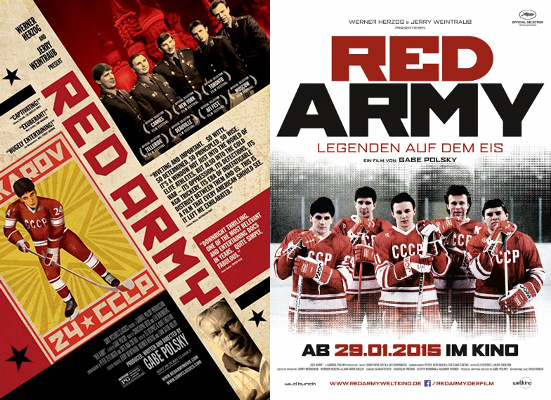 |
| North American and german theatrical poster for Red Army. |
The documentary film "Red Army", currently in cinemas, doesn't contradict this either, but it showcases a perspective on it that will be almost completely unfamiliar to most western audiences. The film follows the career of Hall of Fame defenseman Viacheslav "Slava" Fetisov who became a member of CSKA at the age of 10 and made his professional debut at 16.
The first turning point of the film is the replacement of head coach Anatoli Tarasov with Viktor Tikhanov, both for the CSKA club as well as the soviet national team. Tarasov, a mentor to Fetisov and "the father of russian hockey", is portrayed as a passionate but fair man who considers sports a form of art and attempts to find information useful to hockey even in things like chess and ballet. This is put into direct contrast with Tikhanov's dictatorial persona and relentless practices earning him the spite, but also the desired fear, from his players. As Fetisov later explains, he was respected as a coach but not as a human being because Tikhanov himself did not respect his players as human beings. Tikhanov's popularity is not helped by the fact that he was installed mostly for political reasons.
The film then proceeds to the Miracle on Ice, the first great disappointment in Fetisov's career. The loss sent ripples throughout the Soviet hockey system, leading to the replacement of several players and coaching staff on the national team. However, this also led to the formation of the CSKA hockey club's "first block" consisting of Fetisov, his defense partner and best friend Alexei Kasatonov, and a forward line including Igor Larionov, Vladimir Krutov and Sergei Makarov. Legendary goaltender Vladislav Tretiak is also featured.
 |
| Kasatonov and Fetisov in the back, Makarov, Larionov and Krutov in the front. |
The documentary shows some truly artistic plays performed by this group of players. Immaculate passing showing up the opposition, whose heads spinning of their necks can nearly be observed. This is also the point where even dyed-in-the-wool fans of western hockey have to admit that for the "evil team", the soviets played a very beautiful style. Rapidly they earn gold in the 1984 and 1988 Olympics.
But with the Soviet Union faltering, players are trickling into the NHL. The defection Alexander Mogilny is put into focus. The politburo of the USSR sees the necessity of allowing the Federations star players to leave for the west, though most have to surrender half their salary to the Soviet authorities. This is welcome to Fetisov, who had a falling out with Tikhanov which had rendered him almost a political prisoner in his own country.
In the end all the members of the first block would end up playing in the NHL, but they were in for a Rude Awakening. The NHL was much more rough and tumble than the soviet league, and the contrast to the russian style of beautiful passes and full team play is staggering. The skills of the russian players could not really be properly applied in an NHL system, and the fact that the members of the first block were entering the twilight of their careers didn't help much either.
That is to say until Scotty Bowman, who had observed the russians in an international capacity often enough, managed to get five Russians on the Red Wings. Fetisov was the final piece added to his former CSKA teammate Larionov as well as Sergei Fedorov, Vyacheslav Kozlov, and Vladimir Konstantinov. The group clicked immediately and helped the Red Wings win the 1997 Stanley Cup (despite me hating every second of it). The Stanley Cup makes an appearance on the Red Square.
The movie continues in showing several more Russian imports impacting the NHL, including first overall picks Ilya Kovalchuk, Alexander Ovechkin and Nail Yakupov. This is contrasted with Fetisov explaining his feelings that what his country lacks nowadays is patriotism. The point his hammered home, quite literally, with cuts from a video of Alexander Ovechkin taking shots at Matryoshka dolls to demonstrate his accuracy. Meanwhile Fetisov himself has become Russia's Minister of Sport, while Kasatonov has become Vice President of CSKA and Tretiak the president of the russian hockey federation.
In the end the viewer is left wondering. The totalitarian circumstances in communist Russia were despicable, but it is also undeniable that it brought forward some of the greatest hockey players in the world and one of the greatest teams that ever existed. Could they have become what they were anywhere else? At the very least the film shows a human perspective of these factors and life as a hockey player in the USSR, which is too often neglected when observing from the west as the avatars of the political system.
When I sat in the cinema my first point of criticism was that the movie essentially starts in 1978. As a Flyers fan the love-hate relationship between the Fred Shero's Bullies and the Soviet Union would have been something I would have liked to see featured. Shero, himself the son of russian immigrants, was after all friends with Anatoli Tarasov, studied russian hockey, and imprinted a part of this on his team even before the infamous clash in 1976. However looking back it is understandable that this was left out as it would have somewhat put the horse before the cart. Since Fetisov wasn't a member of CSKA's professional team yet, it was also a bit out of scope.
Nevertheless, "Red Army" is quite a remarkable documentary that can only be highly recommend to any hockey fan. It should also expand some horizons for some fans who have had the western perspective of hockey during the Cold War imprinted on them, and that is a genuinely good thing.

